
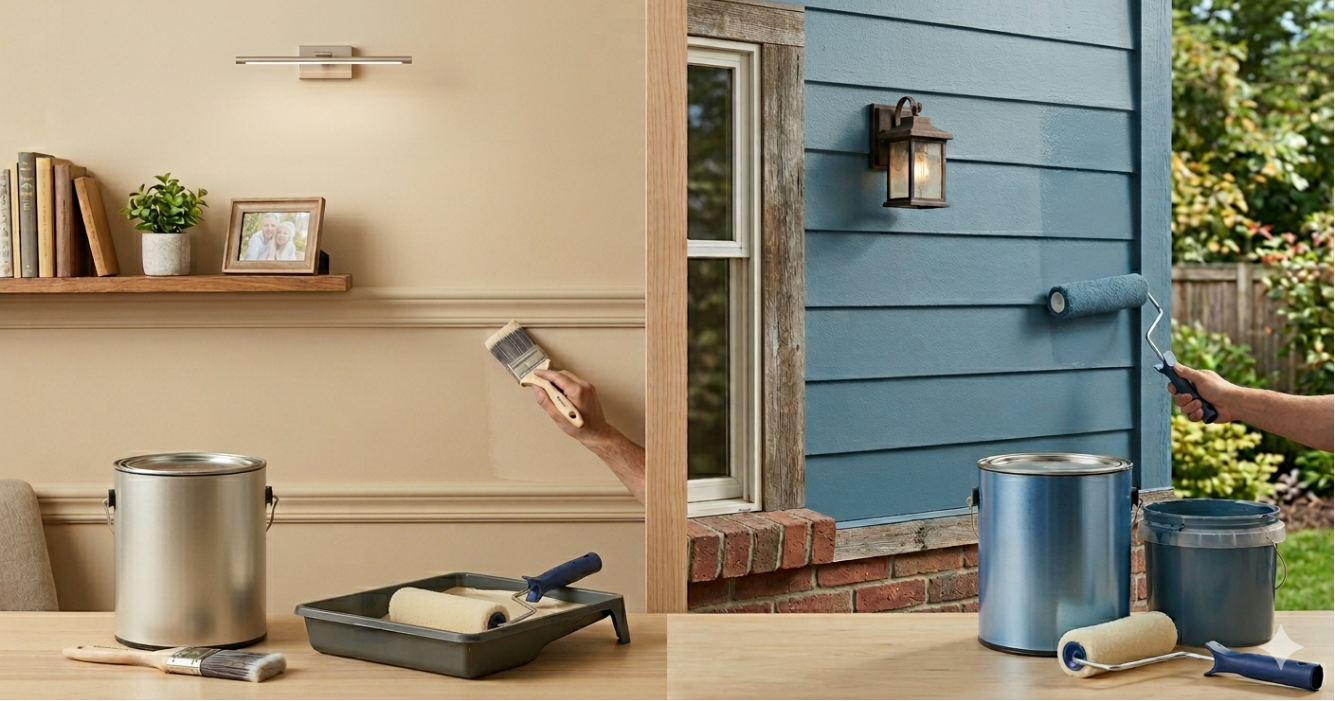
Walk into any hardware store in Kalgoorlie and you’ll find rows of tins labelled “interior” and “exterior.” Most people assume it’s a minor distinction — maybe exterior paint is just tougher, or cheaper, or comes in different colours. In reality, interior and exterior paints are chemically different products engineered for completely different environments, and confusing them is one of the most common reasons paint jobs fail early. This guide breaks down exactly what separates them, why it matters in the Goldfields specifically, and how sheen level, primer choice, and substrate type all feed into the decision.
01 Why Interior and Exterior Paints Are Fundamentally Different
At the chemistry level, paint is made of four things: pigment (colour), binder (the film-forming resin that holds everything together), solvent (water in water-based paints, mineral turpentine in oil-based), and additives (everything from mildew inhibitors to UV stabilisers). Interior and exterior paints share the same basic structure — but their binders and additive packages are engineered for radically different performance requirements.
Exterior paint: built to survive the outdoors
Exterior paint is formulated for flexibility. Outdoor surfaces — weatherboard, render, timber, metal, concrete — expand and contract with temperature changes. In Kalgoorlie, where surface temperatures can swing from near-freezing overnight to 60°C+ on a dark exterior wall in summer, that thermal movement is extreme. An exterior paint film must flex with the substrate rather than crack under the strain.
To achieve this, exterior binders (typically acrylic) remain relatively soft after curing. This flexibility is complemented by UV-stabilising additives that slow the breakdown of the binder by solar radiation, and biocides that inhibit mould, algae, and lichen growth — particularly relevant during the rare but intense rain events the Goldfields does receive.
Interior paint: built for a controlled environment
Interior paint is formulated for hardness. Inside a home or office, temperature swings are smaller and UV exposure is minimal. What matters indoors is a paint film that dries hard, resists scuffs and abrasion, can be wiped clean, and doesn’t off-gas harmful compounds in an enclosed space.
Interior binders cure harder than exterior formulations, producing a tighter film that’s more resistant to physical wear. They use fewer volatile organic compounds (VOCs) and don’t contain the biocides or UV stabilisers that exterior paints need — compounds that would be wasted indoors and, in the case of biocides, are undesirable in living spaces.
Important
Never use exterior paint inside a home or office. The biocides and higher-VOC additive packages in exterior formulations are not designed for enclosed, inhabited spaces. Off-gassing in poorly ventilated rooms can cause respiratory irritation. If someone quotes you an "exterior grade" product for an interior job, that's a red flag.
02 Side-by-Side: Interior vs Exterior at a Glance
Interior paint
- Binder type: Hard-curing acrylic
- UV resistance: Minimal — not needed indoors
- Biocides: Low or none
- VOC level: Low — safe for occupied spaces
- Flexibility: Lower — resists scuffs
- Washability: Excellent — hard film
- Goldfields climate fit:
Ideal for interior surfaces
Exterior paint
- Binder type: Flexible acrylic
- UV resistance: High — UV stabilisers included
- Biocides: Included for mould/algae resistance
- VOC level: Higher — ventilate during application
- Flexibility: Higher — moves with substrate
- Washability: Good but softer film
- Goldfields climate fit:
Essential for all exterior surfaces
03 Understanding Sheen: The Decision Most Homeowners Get Wrong
After choosing the right product type, sheen level is the second most important decision — and the one most homeowners make based on personal preference rather than practicality. In a climate like Kalgoorlie’s, sheen choice directly affects how long your paint job performs.
Flat / Matt
- Best for: Interior ceilings and low-traffic walls.
- Key benefit: Hides imperfections best.
Low Sheen
- Best for: Interior walls and exterior walls.
- Key benefit: Known as the Goldfields workhorse finish.
Satin
- Best for: Hallways, kitchens, and bathrooms.
- Key benefit: Highly washable with a subtle sheen.
Semi-Gloss
- Best for: Interior trims, doors, and skirting boards.
- Key benefit: Very hardwearing.
Gloss
- Best for: Exterior trims, front doors, and feature elements.
- Key benefit: Provides maximum durability.
Sheen for exterior surfaces in the Goldfields
Low sheen (also called satin) is the standard recommendation for exterior walls in Kalgoorlie. It has just enough reflectivity to deflect some UV radiation rather than absorbing it, which slows colour fade. It’s also easier to clean red dust from a low-sheen surface than from a flat finish, where dust can embed into the slightly porous film.
Full gloss is reserved for exterior trims, doors, and metal surfaces — where maximum hardness and moisture resistance matter more than hiding surface texture. On large exterior wall areas, full gloss is rarely used because it highlights every surface imperfection and can look clinically harsh in the Goldfields sun.
Sheen for interior surfaces
Ceilings almost always get flat or matt — the zero reflectivity hides plaster joints and roller marks. Living room and bedroom walls typically get low sheen, which is washable enough for normal use without looking shiny. High-traffic areas — hallways, kitchens, kids’ rooms — benefit from satin or semi-gloss, which can withstand repeated cleaning. Trims and doors get semi-gloss or gloss to take knocks without chipping.
Common mistake
Using flat paint in a kitchen or bathroom might look elegant, but flat finishes are porous and can't be wiped down without damaging the film. Steam, grease, and cleaning products will degrade a flat paint surface within a year in high-use rooms. Use satin or semi-gloss wherever the wall will regularly encounter moisture or cleaning.
04 Primer: The Step That Determines Everything Underneath
Paint primer is a separate product applied before the topcoat whose job is to seal the substrate, improve adhesion, and block stains. In the Goldfields, primer selection matters more than in most places — because local substrates present specific challenges that a wrong primer choice won’t solve.
Oil-based vs water-based primers
Oil-based primers penetrate bare timber deeply, sealing the grain and providing excellent adhesion for topcoats on raw wood — important for weatherboard homes, timber window frames, and external joinery across Kalgoorlie. They also block tannin bleed (the brown staining that occurs when timber sap migrates into water-based topcoats) far more effectively than water-based primers.
Water-based primers have improved significantly and now handle most interior applications well. They dry faster, have lower VOC levels, and are easier to clean up. For plasterboard, previously painted surfaces, and most interior substrates in good condition, a quality water-based primer is the right choice.
Sealer primers for porous surfaces
Unpainted brick, rendered masonry, and concrete are highly porous — they absorb paint like a sponge, resulting in uneven coverage and wasted product. A masonry sealer primer locks down the porosity before the topcoat is applied, dramatically improving coverage and adhesion. On Kalgoorlie homes with rendered exteriors, skipping the sealer coat is one of the most common reasons exterior repaints look patchy and require more coats than quoted.
The topcoat gets the compliments. The primer does the real work.
— Trade principle, echoed by every experienced painter in the Goldfields
05 Common Myths About Paint — Busted
A lot of bad decisions come from paint myths that circulate among homeowners. Here are the ones that come up most often in Kalgoorlie:
Myth 1: More coats always means better results.
- Fact: Two topcoats over a properly primed surface outperform four thin coats over bare substrate every time. The preparation and primer do more heavy lifting than extra topcoats.
Myth 2: Paint covers everything — including surface damage.
- Fact: Paint follows the contours of the surface. Cracks, holes, and rough patches must be filled and sanded beforehand. In fact, paint often amplifies imperfections under raking light rather than hiding them.
Myth 3: White paint is just white — there’s no difference between brands.
- Fact: Pigment concentration, binder quality, and additive packages vary enormously between budget and premium paints. A premium white contains significantly more titanium dioxide (the hiding pigment), which translates to better coverage in fewer coats and much longer color stability.
Myth 4: You can use any leftover paint for touch-ups — even years later.
- Fact: Paint begins to fade from the moment it is applied. A touch-up using the original paint on a wall that is a few years old will almost always stand out. The right approach is to color-match the wall’s current tone rather than reaching for the original tin.
06 What This Means for Your Next Painting Project
Understanding paint chemistry doesn’t mean you need to become an expert — that’s what a professional painter is for. But knowing the basics helps you ask better questions and avoid being sold the wrong product or shortcuts on preparation.
When you’re planning any painting project in Kalgoorlie, here are the questions worth asking your painter:
- What specific product are you using for the topcoat, and is it rated for this climate?
- What primer system are you using, and why is it right for this substrate?
- What sheen level do you recommend, and what’s the reason?
- How many coats are included, and what does that include — primer, undercoat, topcoat?
- Are you using Australian-standard products, or budget imports?
A professional who knows their trade will answer these questions in detail without hesitation. The answers tell you a great deal about how the job will actually be executed.
Pro tip
Ask to see the product data sheet (PDS) for the paint being used. Every reputable manufacturer publishes these — they specify application temperatures, recoat times, coverage rates, and recommended sheen levels for different applications. If your painter can't produce one, that's worth knowing.
Frequently Asked Questions
Can you use exterior paint inside a house?
Technically possible, but not recommended. Exterior paints contain biocides and UV stabilisers that off-gas in enclosed spaces. They also stay softer after curing than interior paints, so they won’t achieve the hard, washable finish that interior formulations deliver. Use the right product for the environment.
What sheen level should I use for exterior walls in Kalgoorlie?
Low sheen (satin) is the standard for exterior walls in the Goldfields. It has enough reflectivity to deflect UV, sheds dust reasonably well, and doesn’t highlight surface texture the way a gloss would. Reserve full gloss for exterior trims and metal surfaces.
How many coats of paint does an exterior job in Kalgoorlie need?
A professional exterior repaint typically requires one primer coat plus two topcoats on properly prepared surfaces. Raw or previously unpainted timber and masonry often need an additional primer coat. Skipping coats is one of the most common causes of early paint failure.
Does paint colour affect how long it lasts on exterior surfaces?
Yes. Darker colours absorb more UV and heat, which stresses the paint film faster than lighter colours. In the Goldfields, pale and mid-tone exterior colours generally outperform very dark tones in terms of longevity. Some premium exterior systems include heat-reflective pigments designed to help darker shades perform more consistently.
Goldfields Painters is Kalgoorlie’s Master Painters Australia-registered painting contractor. With over 25 years of industry experience, the team uses premium Australian-standard paint systems and takes the time to prep every surface properly — because the right product, applied the right way, is what makes the difference between a paint job that lasts and one that doesn’t.