
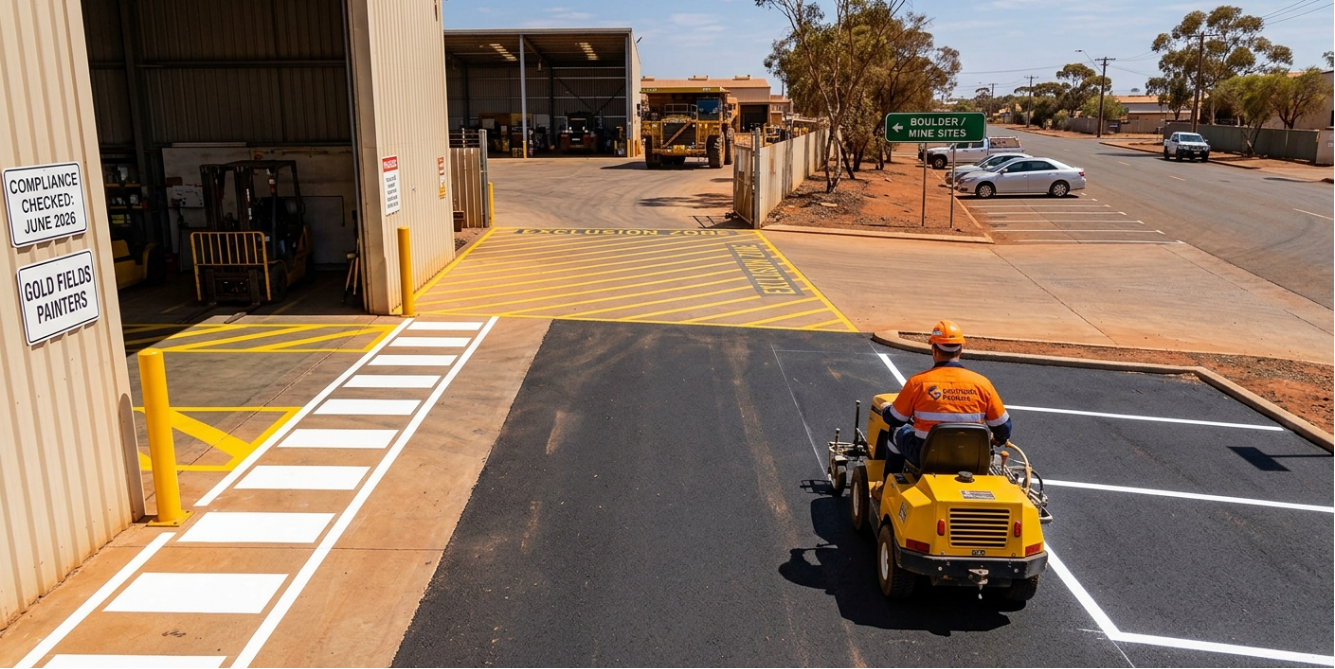
Line marking doesn’t get much attention until something goes wrong. A car park with faded bays causes confusion and complaints. A warehouse floor with worn-out safety lines fails a compliance inspection. A loading dock without clear directional markings ends up with a near-miss incident that could have been avoided.
It’s one of those things that quietly does a lot of work — and only gets noticed when it isn’t there.
If you manage a commercial property, warehouse, industrial facility, or any site with vehicle or foot traffic in the Goldfields, here’s what you need to know about line marking: what it covers, why the quality of the job matters, and how to know when it’s time to act.
What Line Marking Actually Covers
Line marking is a broad term for any painted markings applied to floors, pavement, or hard surfaces to manage traffic, define spaces, communicate rules, or meet safety and compliance requirements.
In practice, that includes:
- Car parks and parking facilities. Bay lines, disabled parking bays, no-parking zones, directional arrows, pedestrian crossings, and kerb markings. A well-marked car park moves traffic predictably and reduces disputes between users.
- Warehouses and distribution centres. Aisle markings, forklift traffic lanes, pedestrian walkways, hazard zones, and emergency exit paths. In a working warehouse, clear floor markings are a frontline safety measure — they separate people from moving machinery and keep operations running efficiently.
- Industrial sites and workshops. Safety perimeters, equipment exclusion zones, chemical storage areas, and loading bay markings. These aren’t optional niceties — many are required under Australian workplace health and safety legislation.
- Commercial and retail premises. Internal floor markings in large retail spaces, fire exit routes, customer queuing systems, and external pedestrian areas.
- Sporting and recreational facilities. Court markings, running track lines, car park overflow areas for events.
The Goldfields has a significant industrial and mining services sector, meaning line marking for workshops, maintenance facilities, and logistics operations is a common and ongoing need across the region.
Why the Quality of Line Marking Matters More Than People Think
Not all line marking is equal. The difference between a professional job and a rushed one becomes obvious within months — and the consequences go beyond appearances.
- Durability. Line marking is subject to constant wear from vehicle tyres, foot traffic, forklift wheels, and cleaning equipment. Cheap traffic paints applied without proper surface preparation fail quickly — they peel, chip, and fade to the point of illegibility. Quality traffic-grade paints, applied correctly to a clean and properly prepared surface, can last years under heavy use.
- Compliance. Australian standards and WHS legislation set specific requirements for line marking in workplaces — width of pedestrian walkways, colour coding for hazard zones, specifications for disabled parking bays. Using the wrong paint, the wrong dimensions, or the wrong colours isn’t just a quality issue. It can mean a failed compliance audit or, worse, contributing to a workplace incident.
- Visibility. Line marking only works if it can be seen clearly. In dusty Goldfields conditions — common on mine sites, in workshops, and around industrial yards — markings need to be crisp and high-contrast to remain effective. Faded or poorly applied lines in a working environment are a real safety risk.
- Surface preparation. As with all painting work, the quality of a line marking job is largely determined by what happens before paint goes down. Surfaces need to be cleaned, degreased, and free of loose material. Any existing markings that are being changed need to be properly addressed. Skipping this step results in poor adhesion and premature failure.
The Specific Demands of the Goldfields Environment
Line marking in Kalgoorlie and the wider Goldfields faces some conditions that aren’t present everywhere.
The heat is the most obvious factor. Surface temperatures on exposed asphalt and concrete in summer can far exceed air temperature — 60–70°C on dark surfaces isn’t unusual. This accelerates the breakdown of inferior paints and can affect adhesion if surfaces aren’t properly managed during application.
Red dust is another constant challenge. Fine mineral dust settles on everything and acts as a barrier between surfaces and coatings. On industrial and mine-adjacent sites, this is a particular issue — thorough cleaning before any marking application is non-negotiable.
UV radiation in the Goldfields is intense year-round. Exterior line markings — in car parks, yards, and external facilities — need UV-stable pigments to maintain colour and visibility over time. Markings that look bright on day one but fade within a season are not fit for purpose.
Heavy vehicle traffic on industrial sites puts extraordinary wear on floor markings. The right paint specification — including primers and top coats designed for heavy traffic and forklift loads — is essential for markings that last.
When to Remark or Refresh Your Markings
A common question is how often line marking needs to be redone. There’s no single answer, but there are clear indicators that it’s time to act:
- Fading or illegibility. If bay lines, safety zones, or pedestrian walkways are hard to make out, they’re no longer doing their job. Don’t wait until they’ve completely disappeared — faded markings are confusing and can be a liability.
- Layout changes. Expanding a warehouse, reconfiguring a car park, adding new equipment, or changing traffic flow patterns all require updated markings. Old lines left in place alongside new ones cause confusion and safety issues.
- Compliance requirements. If your site is due for a WHS audit or council inspection, ensure your markings meet current standards before the inspection — not after.
- Surface repairs. If an area of concrete or asphalt has been repaired or resurfaced, the markings over it will need to be redone. Patched surfaces are also an opportunity to reassess the overall marking layout.
- New builds and fit-outs. Any new commercial or industrial building needs line marking as part of the fit-out before it can be safely occupied and operated.
Getting the Job Done Right
Line marking is a specialist service within the painting trade. It requires the right equipment — line marking machines that produce consistent widths and crisp edges — as well as knowledge of the correct paint specifications for each surface type and application.
For car parks, the relevant Australian standard is AS/NZS 2890, which sets out dimensions for parking bays, clearances, and disabled parking requirements. For workplaces, WHS regulations set minimum standards for safety markings. A professional line marking contractor will be familiar with these requirements and apply them as a matter of course.
It’s also worth noting that line marking on active sites — a working warehouse, an operational car park, a live industrial facility — needs to be managed carefully. This means working in sections, scheduling around operations, and ensuring markings are dry and cured before traffic resumes. Good communication and planning are as important as the technical execution.
Line Marking Across Kalgoorlie, Boulder, and the Goldfields
At Goldfields Painters, line marking is part of our full-service offering alongside residential, commercial, and industrial painting. We work on car parks, warehouses, workshops, and industrial facilities across Kalgoorlie–Boulder and the wider region, using traffic-grade paints suited to Goldfields conditions.
We’re registered with Master Painters Australia, fully insured, and we bring the same preparation standards to line marking that we apply to every other job we do — because a marking that fails in six months costs more than one that lasts five years.
If your facility is due for a remark, a layout change, or a new fit-out, we’re happy to come out, assess the site, and give you a written quote.
Call us on 0417 963 773 or visit goldfieldspainters.com to get in touch.
Goldfields Painters — Kalgoorlie, WA. Residential, commercial, and industrial painting specialists, including line marking for car parks, warehouses, and industrial facilities.